Friday, December 29, 2017

Dialysis Patient And Will Travel. #dialysistraveler

Dialysis Patient And Will Travel
#dialysistraveler


At Disney Sea Man-Made Lagoon


Me having dialysis at St. Lukes International Hospital


I am 65 years old and an End Stage Dialysis
Patient for six years now and I do not believe on someone who says that dialysis patients could not travel to other places like in their dreams. I have proven them wrong when my daughter Nadinne, who is a dialysis nurse in Australia carefully and painstakingly planned for a Singapore/Japan family travel and finally decided to push through with the said trip; of course I am included. Yes it is risky but it is worth taking the risk. At first I was not used to traveling but my body has adjusted to the situation and I started to enjoy: the fast boat to Cebu City and the airplane ride to Changi Airport in Singapore with my wife to rendezvous with my daughter Nadinne and my Son-In-Law Joshua who are coming from Australia. Changi Airport was decorated with beautiful flowers and orchids and we did not miss the photo opportunity  to pose and take pictures. Security and screening of incoming travelers is tight inside the airport as we pass the Custom's Area. As we went outside the airport I noticed that Singapore City is very clean and the climate is just right (not too hot and not too cold) the people are friendly and very organized. 

We took a van for hire and I gaze on the type of the van and it was a Mercedez Benz. People in Singapore have money I said to myself. There was no traffic congestion and our travel from the airport to the condominium unit of Joshua's brother was very smooth. After leaving our baggage and settling a bit, my wife, my daughter and her husband Joshua and Joshua's brother Jay and his family walked as I rode the wheelchair assisted by Joshua to the mall near their vicinity and we ate a dinner with assorted foods like crabs, fish, pork and noodles. I noticed in the basketball court and beside the mall  that we passed by that there were bicycles with the same design and color just left behind on their stand. I asked and I learned that those bicycles are owned by the government and can be used by means of a cell phone app. My impression is that it is a peaceful place and the government is very considerate to provide easy transport to their citizens. The government recognizes the importance of taking care of the environment by caring for trees and plants (the roads and hillside are lined with flowers and lush garden plants and trees). This is also true for Person With Disability (PWD) as malls, airports and train stations are provided with line of steel strips that guide the blinds and there are sufficient lifts or elevators to facilitate travel. We spent our night in the four room condominium unit of Jay and his family. The unit has enough space for a small family and has ample amenities. 

During our talk with Jay that night I have learned that in Singapore, you cannot own a land; you pay a certain amount for the condominium unit and if the government decide that another project will be put up at that place, they will pay you back what you paid to be used to pay the new unit that you will transfer in. The same is true if you decide to transfer to another place. That is why it is easy for the government to do Urban Planning. Most people are housed in condominium type (four to nine stories high) buildings and are clustered to form a community. Each community is provided with a mall and other necessary facilities to avoid unnecessary movement of people to prevent congestion in the streets. There is less visibility of uniformed policemen and crime is minimal.Taxes are high but wisely spent in various projects like infrastructure; not like in the Philippines where collected taxes were used to finance political projects aside from loss due to corruption. Please write your opinion in the comment section. It does not matter if you agree or disagree. Varying opinions is good. 

There are many Filipino workers in Singapore mostly professionals, Domestic Helpers and waiters in restaurants. Jay has hired one house help (distant relative of his mother). Hiring a house help in Singapore is not cheap; you have to pay a certain amount to the government on a monthly basis aside from the regular monthly salary. The employees and workers are well paid that is why they are contented and do their job well. I think there is job for everyone in Singapore. Just like in the Philippines there are rich people in Singapore and their income, quality of life differs quite significantly from other citizens. They say that if there is corruption in Singapore, it is very low.


Changi Airport
Changi Airport
On our second day in Singapore, we rode the train and I noticed immediately that the train system and network  is well planned (passenger friendly), well maintained and sufficient (there is a train passing by every five minutes) for mass transport that somehow prevented traffic build-up in the streets. The trains were new, clean and air-conditioned. People in Singapore love spicy foods, that is why you smell a spicy scent when you ride a train. It was like a maze inside the train station as we manage through escalators and stairs (sometimes we take a short cut) as lifts or elevators were not available (this is the hard and painful part as I am forced to stand from my wheel chair and walk). People are courteous and ready to help tourists to find their destination. The train took us near Sentosa Island, a leisure park accessible by cable cars. High above, you can see the bird's eye view of metro Singapore. You can ride the cable cars that loop around the island as long as you want. After stepping down from the cable car, we familiarized ourselves with the area and we later each of us rode the Luge (small cart with wheels) that can be easily maneuvered as it rolled down a slope and turns in snaky curves downhill. A cable lift took us back to the top of the hill where we came from.


View from the cable cars

Me and my wife at the boarding area of cable cars


Jay and his daughters and wife

Driving the Luge cart


Joshua, Belen, Me and Nadinne


At the Luge Entrance Area

Then, there was this four dimension movie house where you can see 3 D objects like logs, sawmill and crocodiles and you can feel the turns and bumpy ride in synchrony with the carousel you are riding in as it simulate the travel of logs in a river as it pass through the waterfalls (you can feel and see the drop) in a canyon until it reached the end of the line below. If someone in the viewers cannot proceed to finish the show due to fear or health problem, he can pull the lever and the show will temporarily stop and will proceed again after the said viewer that pulled the lever has left the room. There are enough food kiosks to satisfy hungry tourists. The sandwiches are very delicious, a little bit spicy and tasty. We visited the big MerLion statue where we climbed up to the top to see the panoramic view of Singapore. 

We continued to tour the area and posed for more pictures and proceeded to Universal Studio area located at the lower portion within the vicinity of Resorts World where there is a mall for celebrities selling signature clothes, bags and other items; of course aside from the delicious foods from many food stores. We posed for more pictures outside the mall with the original Merlion Fountain in the background at the other side of the Marina Bay area. We went back to the loading area of cable cars that took us back to mainland Singapore where we took a train going to China Town where we ate a sumptuous dish of Peking Duck, then after eating we looked for souvenir items for our friends back home.


On top of the Big Merlion Statue

At the Resorts World Vicinity
At the big Merlion Statue
Part of Sentosa Island (lower portion)


Part of Sentosa Island (lower portion)
Within the vicinity of Resorts World


On the third day we went to church. I noticed that there were many Filipinos and in fact the priest has announced that there was a schedule for a Filipino Mass. The church is huge and air conditioned. Then we ate breakfast in a Chinese restaurant and afterwards we rode the train to Gardens By The Bay area where we entered the  Cloud Forest. I was in awe at first sight of this man-made structure. Fogs and clouds were simulated inside a huge enclosure of glass that house a man- made mountain covered with many (I think all known tropical species were there) type of plants, flowers and orchids complete with water falls that create fine mist making the area more colder aside from huge air conditioners and misters. I admire very much 

Cloud Forest Waterfalls


Pose with huge palm trees


how Singapore give priority to large expensive projects about nature yet viewing it as an investment (boosting the tourism industry) with calculated financial returns. The Cloud Forest can be explored by the use of elevators and walk way around the man-made-mountain. We transferred to another gargantuan glass enclosure called the Flower Dome and toured the different types of plants as to countries like Asia and Africa. My wife Belen was all the while very happy and smiling as she looks at the flowers and orchids and Cacti (plural of Cactus) of various colors and sizes. Truly it is a gardener's and tourists' paradise. 


Belen with the Cloud Forest walkway at the background


There was a Santa's Cabin where many people lined up and waited for their turn to pose for family or group pictures. There were various Christmas lights twinkling in the area. As the dusk progresses, we watched the Super Trees light up with the huge merry Christmas lights and the beautiful Marina Bay Sands Hotel at the background. We left the Gardens By The Bay area and crossed a bridge to reach the original Merlion Fountain. We arrived at the Merlion Fountain with the Marina Bay Sands Hotel at the background in all its grandeur and glory as it perform the nightly laser lights and fountain show. It was awe inspiring as we pose for pictures beside the famous MerLion fountain that was popularized by a legend of a Mermaid with a lion head signifying the start of development of Singapore. 

Being a disciplined dialysis patient, I managed to survive the three day tour without dialysis. We went back to Cebu City and finally back to Tagbilaran City, Bohol where I had my regular dialysis.


Merlion Fountain


Super Tree at the Gardens By The Bay Area


My wife Belen at Merlion Fountain


Marina Bay Sands Hotel


Marina Bay View

After a few days rest, we traveled again from Tagbilaran City, Bohol to Manila on December 17, 2017 and the next day I had my dialysis at St. John Dialysis Center at Casman Bldg. at Quezon Avenue in Quezon City. I usually had my dialysis in Manila at Capitol Dialysis Center but now it is full to third shift and cannot accommodate transient patient like me.

On December 19, 2017, we started the second part of our tour which is Japan, particularly Tokyo, Kyoto and Osaka. When we landed at Narita Airport, I was surprised to see my name written in a placard held by a  young Japanese male attendant who was formally dressed all over in an attractive American suit. I did not know that my daughter has arranged for a wheel chair service because I have muscle and joint pain which is typical for a 6th year dialysis patient like me. The attendant was very courteous and helpful with smiling face. Narita Airport is huge, clean and very organized. The people are very courteous and very helpful of tourists. I had my first feel of Japan's weather when we went outside the airport to the train station and took a train that will take us to Tokyo. Boy it was really cold. Temperature inside the train was controlled by heaters maybe at room temperature and there were many passengers, so I had to take off my jackets and gloves again and put them back again when we reached Tokyo. I was not used to those heavy clothes, I felt I was so heavy and could not move properly. Using the GPS and walking, we searched for our Air BNB lodging house. Flag down rates of taxi in Tokyo was 4,000 Yen as they say. After some turns around the block we found our apartment type lodging house with two bedrooms that accommodated eight persons complete with heaters, WIFI, food snacks, appliances, soft cushioned beds, thick comforters and comfort room with toilet and bath. There was hot and cold water and the toilet have very modern electronic amenities with a touch of a button: Videt (focuses and wash a certain private part of your body), sprinklers (wash private parts with assistance of the hand). There are other buttons but I cannot understand because it is written in Japanese. My wife told me that it has a music button. Of course the music is in Japanese. At first I was hesitant to use the toilet bowl but I focused on the illustrated drawings and started experimenting. Then, at last, success! 

We first visited Senso-Ji Temple at Asakusa, Tokyo, Japan in the evening. I forgot to wear the right clothing for winter (gloves; scarf; thermal suit) and I felt so cold and I was afraid I would pass out especially when a slight wind is blowing. Thanks to the small food kiosks that line the streets that offered a cozy place and a hot meal. I can say I enjoyed but felt uncomfortable also because of the very cold weather. Then we went back to our lodging house and got a little nervous after getting lost in the streets for a while with my Son-In-Law Joshua who was pushing my wheelchair. Despite the cold weather outside I slept well that night.

Senso-Ji Temple
Senso-Ji Temple
House near Senso-Ji Temple

The second day is thrilling for us since we have to ride trains inside Japan's subway known for its maze like and not tourists friendly signs (all are written in Japanese); but thanks to the GPS and Google translations, we managed to find our way. At the train stations I noticed that all of the people are walking in wide strides and are in a hurry. All are lined up at the left side of the escalators because some prefer to walk in a hurry past other people who prefer to stand in the escalators. Japanese love their work very much and maybe their parents have taught them to value time, respect for other persons and money; it is in their culture. Employees at the train stations are helpful, respectful and polite. They are very professional in their uniforms and behavior. 

 I was reminded of a conversation between two student weight lifters (one student is a Japanese and the other one is Filipino) when I was still a student in College. Based on his observations, the Japanese weight lifter said to the Filipino weight lifter: "Philippines is a pond of frogs". It took a while for me to understand what the Japanese student said. Finally, it dawned on me that the Philippine sports training, as seen by the Japanese student, is sub-standard in terms of quality and quantity of time compared to Japanese training in the field of weight lifting. I was thinking that does this weakness is also true in other Filipino traits like discipline, honesty, self-respect, integrity and commitment and are reflected on how we work in the office whether it is in the private and government? Does this means that Filipinos are only imitating their leaders' examples but most of their leaders lack on these important traits that's why our country's development is not at par with Singapore and Japan? Am I right? Please put your comments below. 

It was morning in Tokyo and people were going to work. Every passing train was full of passengers and some, men and women, were standing with "zombie" like look on their faces (void of emotion); most were glued to their cell phones with matching earphones and some were comfortably snoring on their seats. Most men are in black suit and the women are in white dress.

Finally, we arrived at our destination for the day, the Disney Sea Theme Park which is the only one in Asia. The area is huge and organized to provide maximum entertainment to people at the right price (it cost 14,000.00 Yen per person) as well as bring in profits to Walt Disney Group. They have replicates of the Little Mermaid, Sinbad and the seven seas travel, Jules Verne's Twenty Thousand Leagues Under the Sea and other cartoons and movie themes. We arrived at the park at 10:30 A.M. and we saw around the man-made lagoon, groups of Japanese teens slumped (seated with folded knees) and clumped near each other at the concrete floor sharing body heat, busily using their cell phones and waiting for a show. Indeed at 11:00 A.M. the show of Disney characters started and there was a lively music and merry dancing around the lagoon. The in-active crowd suddenly jolted up to their feet and began waving and shouting with very happy faces. 

Then we strolled around the kingdom of little mermaid Ariel, pose for photos including the water fall at the foot of a man made volcano that formed part of Indiana Jones adventures. Inside the man-made volcano is a roller coaster ride where you can see and hear teens and kids enjoying the ride with loud shrieks. We did not ride the roller coaster but we chose the Twenty Thousand Leagues Under The Sea. Using the winding steel staircase we descended deep into a dark cavern and rode a miniature old model submarine. This ride mimic travel under the sea. As the submarine submerges, you can see in the circular glass window that the water is rising and you can see  curtain of bubbles. The lights and sound of the sea is great as well as the sea creatures like the giant octopus which seem to electrify the mini submarine as it passes through. There were many shows like the Big Band and Ariel the floating/flying and dancing mermaid. We became priority on every show because I rode my wheel chair and got good viewing. Then the night at about 7 P.M. was capped by a Mickey Mouse Mystical show of fireworks, fountains and orchestrated dances of Disney characters in boats parade in the lagoon. 

The night ended very merrily as contented tourists walked back to the Disney train that will take them to the city's train station. The park's attendants and employees were all very courteous and helpful. From the looks of it this is a classic signature of American  capitalists business venture capitalizing on the entertainment needs of children and adults; but satisfying indeed at the right price. We ate our meals in Japanese restaurants and it was there that I have proven that hunger is a great motivator and teacher as I finally learned to use the chop sticks for eating Ramen (fine noodles), Udon (bigger noodles) and Sashimis (set of raw fish, shrimp, squid, vegetables and sticky rice).


Near Ariel's Kingdom


Beside the man-made lagoon
Arabian Knights (Sinbad)
Ariel's (Little Mermaid) Kingdom
Man-made Volcano
Disney Sea (Zuma's Temple)


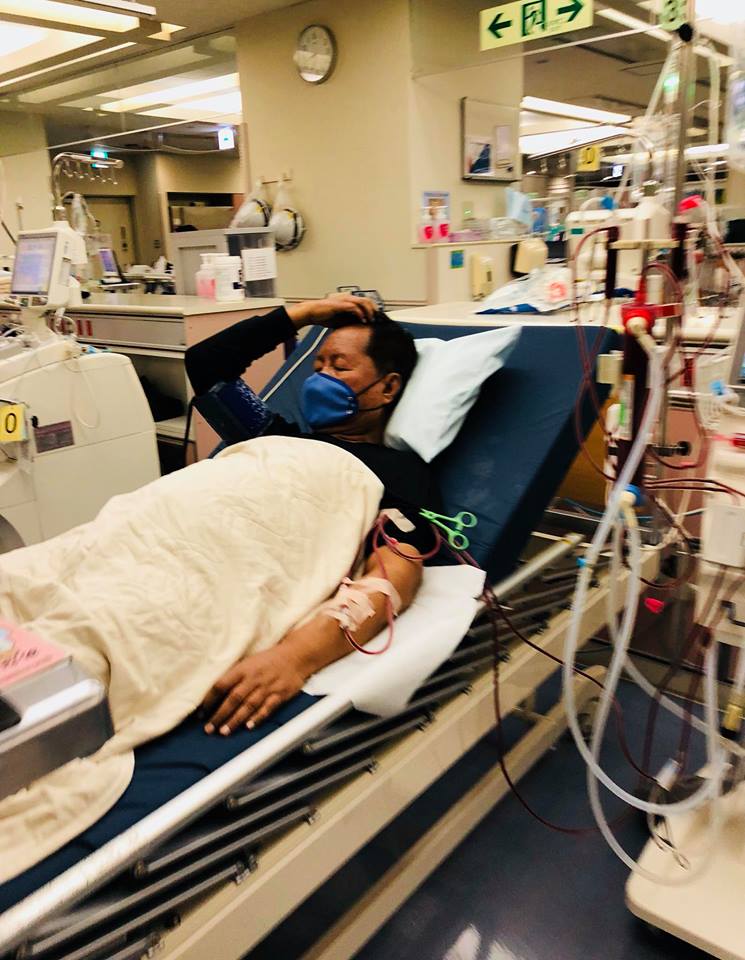
On the third day, December 21, 2017, we packed our baggage and we left our lodging house; we rode the train to the downtown business area and it was very cold outside since there was a prevailing wind. We were able to see the big and modern buildings and did not lose the opportunity to pose for a picture. We went to the bus station to leave our baggage and rode a train again to go to Shibuya crossing (popular for many people crossing the streets at one time) and pose for a family picture beside the statue of Hachiko the loyal dog who waited for his dead master to arrive at the station for many years. Then we ate Sashimis near my dialysis area. Afterwards, I had my first dialysis in Japan at the St. Luke's International Hospital at 3:00 P.M. I had a bit communication gap with the nurses but we were still able to understand each other and my dialysis smoothly went on until it was finished at 7 in the evening. From the hospital, we hurried to take a train ride to the bus station where a bus will take us to Kyoto. Like the participants in the Amazing Race, we were able to arrive at the station with only seconds remaining. The bus ride was 7 hours long but we were comfortable inside and the seats can be reclined. I looked outside as we travel and we were traveling through numerous houses, bus stations (the bus stopped for a few minutes for passengers to relieve themselves and also to take new passengers) and many lighted tunnels as the road to Kyoto is mountainous. When we arrived at Kyoto bus station, Kyoto temperature was 0 degree Centigrade at 4 A.M. and the biting cold was alleviated by a hot McDonald's meal. 

At Kyoto Station, we took a train to visit a Buddhist monk shrine called Fushimi Inari. This tourist site sits at the base of a mountain which is 233 meters above sea level. Trails leading up the mountain includes smaller shrines which span 4 kilometers and take approximately 2 hours to walk. I remained at the lowest portion as my companions climbed up to a few shrines. There were also praying and luck giving paper sheets that are sold by Japanese monks. After looking for food in the line of food stalls and eating Japanese fried noodles, we again took a train to Arashiyama bamboo forest or Grove (group of bamboos). This is where they shoot movies with Ninjas doing sword fights among the bamboos. The bamboos were clean of thorns, big and straight and they were side by side.

For the first time, we were able to ride the "Bullet" train at Shinkansen station going to Osaka. These modern trains are exclusive for those who can afford as the fares are soaring high; but the comfort and speed of travel is well provided. The buildings and other structures from the window seem to blur because of the high speed of the train. We arrived at Osaka in the late afternoon. Our room good for eight persons was of a studio type with heaters, bath, comfort room, kitchen and appliances. Our room in Tokyo was far better compared to Osaka. It is on the third floor and has no elevator and hand railings and it became dangerous and agonizing for me to climb and go down the stairs. No pain (including courage and determination) no gain.
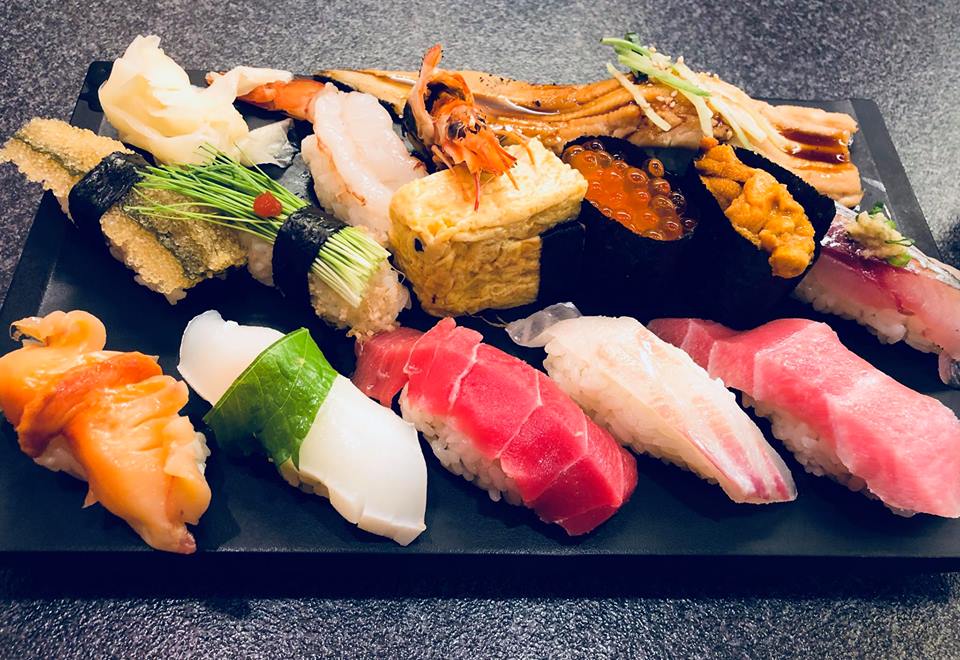


Set of Sashimi items
Downtown Tokyo
Shibuya Crossing

Statue of Hachiko the loyal dog

Fushimi Inari Shrine
On top of Fushimi Inari


Me, Belen, Mariele, Nadinne, Mabelle and Adriane
at Bamboo Forest


Universal Studio (Harry Potter Castle)


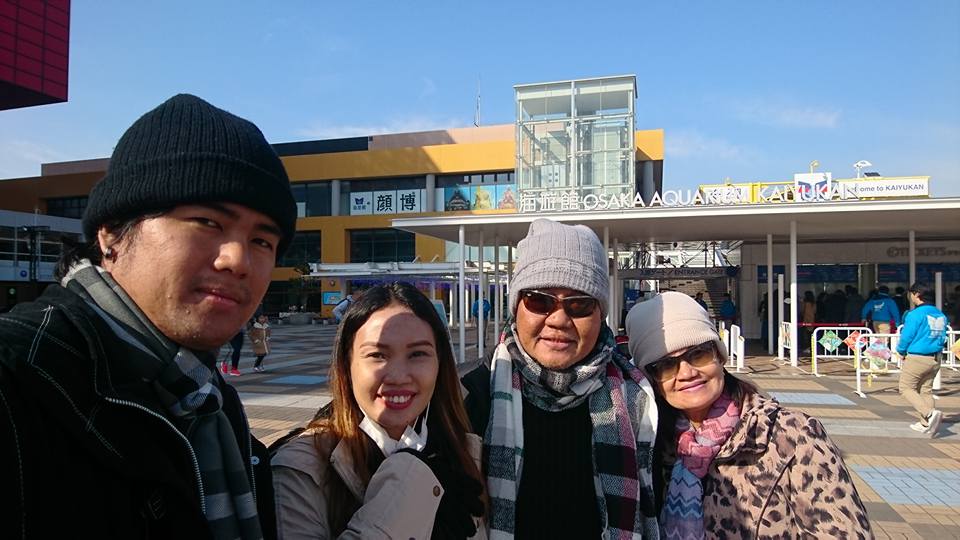
On December 23, 2017, Nadinne with her two sisters Mariele, Mabelle and Joshua went to the Universal Studio while my wife Belen, my daughter Adriane, her husband Joel and I went to the Osaka Aquarium, the largest in Asia, we had some pictures with the whale sharks, other species of sharks, seals, penguins, king crabs and many species of fish; afterwards, we rode a train again and I had my second dialysis at the Shin-Osaka Iseikai Clinic which also went smoothly. The place was modern with complete facilities. I was surprised because I was able to tolerate a hi-flux dialyzer at 240 ml./min. blood flow for four hours straight. 

On our last day at Osaka, we were able to shop (some stores have tax free items) and eat at the Doton Bori, which is the "Divisoria" of Japan. Divisoria in the Phillippines is known for its cheap products and lots of people are shopping in the area. Doton Bori has lots of shopping and food stalls in long line which the tourists and locals can select from. Tourists are queuing in a long line to buy Takoyaki, a Japanese food with octopus as one of the ingredients. There were Koreans, Chinese, Filipinos and a few Caucasian tourists.


Joshua, Nadinne, Mariele and Mabelle


Osaka Aquarium (whale shark)

Joel, Adriane, me and Belen at Osaka Aquarium


Osaka Aquarium (KIng Crabs)


Doton Bori Bridge


Takoyaki (Japanese delicacy)

We again took a train that took us to the Kansai Airport. It is huge like Narita Airport and also very clean and organized. Our flight from Osaka to Manila was at 8:55 P.M. We arrived safely  in Manila at 12:20 A.M. Christmas day.


Our trip has provided enough bonding moments for our family and proved that disciplined dialysis patients can also travel if they are determined to endure physical pain to a tolerable degree. It also shows that countries with good and dedicated leaders can pull out from chaos and poverty to a well developed nation. Not like in the Philippines where full development has continued to lag behind other countries because of too much politicking and ineffective system of doing business and other transactions like the Red Tape that was supposed to provide check and balance became a dragnet for those opportunist gov't employees who are hungry for grease money from private contractors just to facilitate the movement of the required documents for bidding and award of projects and also for almost all gov't. transactions. They justify this by saying they have small salary and this pave for the existing "cancer" like system of corruption perpetrated by syndicates of gov't employees, dirty politicians and private contractors. As a result, the supposed original budget for the project is affected and the contractors have to skim on the project design resulting to a less quality infrastructure or supplies or machines and higher price of commodities. When will we learn from these mistakes and keep away from these evil deeds? Please write your feed-backs or comments. I will love to see them.


Sorry, because I cannot stop from comparing our beloved country the Philippines to other prosperous and developed countries like Singapore and Japan. It is our deepest desire that we Filipinos unite to make our country successful. This is just my way to create awareness no matter how small it is.


I do my travel not just for fun and sight-seeing. I always look for things that I wish our country could have also. 


I thank God for making my travel to other countries possible with the full support of my family. 


I chanced to read in the internet about a dialysis patient who dreamed of joining the Iron Man Triathlon. He did this with passion and determination; and one day he had the chance to fulfil his dream. He joined the Triathlon and was able to finish it.


My message to other dialysis patients is to be brave and try your best to travel to other places like in your dreams while you still can.


Enjoy!


P.S.: Tips for dialysis traveling patients: The first thing to do before you travel is to go to your Nephrologist. Ask her/him if you are fit for travel. Have your blood test for regular monthly tests like Sodium, Potassium, Ionized Calcium, Inorganic Phosphorus, Albumin, Blood Uric Acid, Blood Urea Nitrogen, Serum Creatinine and CBC. Make sure the results are normal or near normal especially that of Hemoglobin value of your blood since Hemoglobin and Iron combined takes care of transporting oxygen to your cells. You do not want yourself panting or gasping for air as you travel from one place to another. You can also feel less cold if your Hemoglobin value is okay. The ideal Hemoglobin value is 11 or slightly higher. Before you travel, make sure your heart is okay and can take the rigorous part of your travel. You do not want to stress your heart to the point that you will have a heart attack. Take your medicines on time and regularly. Make sure your blood pressure is okay. Lastly, be sure to bring a wheelchair with you and a strong companion, preferably a male, to assists you as you ride your wheelchair. Of course, a strong determination, discipline and passion are needed to make your trip successful.


Saturday, June 10, 2017

All About Dry-Weight In Hemo-Dialysis: Rewind


     Estimating the dry-weight (this is the lowest possible weight of a dialysis patient after dialysis where the patient has normal blood pressure and most of excess body fluid is taken out) is hard sometimes because the patient is afraid that he/she might exceed below the actual dry weight and suffer very painful cramps, temporary hearing loss and low blood pressure. On the other hand, not reaching the dry weight after dialysis means retention of extra body fluid that may result to Edema or swelling of the legs and water is stored in the abdomen. Twice, I have experienced that situation when I lost my appetite and not being aware that excess body fluid is stored in my abdomen and my legs and I am way above my actual dry weight. If you experienced this, the right thing to do is not to abruptly take out the excess body fluid in one dialysis session but to slowly take it out one dialysis session after another dialysis session until your legs are not anymore swelling and your stomach is not feeling too heavy. You do this by lowering your estimated dry weight by 300 ml. in one dialysis session, then 500 ml. on the next dialysis session and so on until you begin to feel that your legs is about to cramp or you are about to experience temporary hearing loss. Do not eat salty food as this may cause fluid retention and excess body fluid is harder to take out. It is not necessary to reach your actual dry weight but you should always try to go near it after every dialysis sessions.

     I have experienced that if I am at or near my actual dry weight, my appetite for food is increasing and the result is I get fat and I have to re-adjust my estimated dry weight until I have a big and heavy stomach and my legs begin to swell and I lose my appetite. This means that I am again way above my actual dry weight and I need to lose weight by not eating too much carbohydrate like rice, bread and pastries. I eat small amount of meat and chicken, lots of fish and some vegetables that are high in Vitamins and fiber. I drink less than one liter of water per day. My experience is that if I drink a lot of water, I have observed that I do not feel well during dialysis because my heart is stressed while the excess fluid is being taken out of my body. If I drink only the allowed amount of water, I feel well during dialysis and I can still take out more water below my estimated dry weight until I go near again to my actual dry weight.


     My advice to my fellow dialysis patients: always try to stick on the dos and don’ts of dialysis as I have written in one of my articles in my blog. It is very tempting to exceed the allowed amount of food and water for dialysis patients; but I tell you, the corresponding discomfort or pain during dialysis is not worth the satisfaction you felt when you ate excess amount of food and water. I am reiterating again that we (dialysis patients) should eat to live not live to eat. If you want a longer life in dialysis, you must exercise a strong will to resist the temptation to over eat and drink. You can do it!


Tuesday, May 16, 2017

Life of a Dialysis Patient (Part 3)


Part Three:
    
     I will reach my sixth year on dialysis on September 29 this year. Having dialysis is part experience and more on learning the various technical aspects of dialysis. This is important since I cannot always rely on the doctors and nurses because they can commit lapses sometimes because of their work load. It is I who can tell what I feel and from experiences, research and insights I can prevent mistakes from happening again. Like the estimation of my dry weight (this is the lowest weight I can possibly obtain after dialysis where my vital signs are normal and any excess water from my body is taken out). I have learned to observe during dialysis if the amount of water taken out of my body is already enough and I could instruct the nurse to lower my fluid goal or stop the drawing of water from my body. I know the frequency of injecting Erythropoietin (for maintaining the amount of blood Hemoglobin) based on my latest Serum Hemoglobin test. I know that I should take Calcium Carbonate tablet or Sevelamer tablet (phosphate binders; serum phosphorus level tend to rise in dialysis patients) either before, during or right after meals and not to be taken more than thirty minutes after eating because the phosphorus in my meal is already getting absorbed and taking phosphate binder at this stage is already late. Based on what I feel and the condition of my body, I could instruct the nurse to either lower or increase the rate of my blood flow on the dialyzer.

     I have said that the doctor and nurses could commit a wrong diagnosis or decision sometimes. Like what happened to me on December, 2015. I had a persistent cough with no fever that time and the doctor listened to my lungs and said that she heard something in my left lung. She advised me to have a chest x-ray and the result was I have Pneumonia in my left lung and she gave me strong anti-biotic and after two weeks, my cough did not stop. The medicine she prescribed me made me lose my appetite and I have difficulty sleeping. Again, another doctor from the hospital gave me more strong anti-biotic and this has worsened my condition and one night I have difficulty breathing and my phlegm has a streak of blood in it. I had my dialysis immediately but I was not relieved of my difficulty in breathing so the nurses advised me to be admitted to a private hospital. I rode an ambulance to the Holy Name Hospital without an oxygen tank and this worsen my condition. Upon reaching the Emergency Room I was given oxygen and my condition has improved. The next day our Nephrologist in GCGMH ordered that I be dialyzed again and was repeated again the next day and after that I rested for one day and I was dialyzed again the next day. At the fourth day, my Pulmonologist visited me with our Nephrologist and heart doctor. 

     The findings was I have had fluid overload resulting to Pulmonary Edema and there is water surrounding my heart. My Pulmonologist diagnosed me before my admission that I have no Pneumonia but have water in my lungs. Taking those anti-biotic for Pneumonia had aggravated my condition. On the fifth day I was discharged from the HNU Hospital and continued with my regular dialysis afterwards. I had fluid overload because I lost my appetite and I cannot sleep when I took those anti-biotic. I was supposed to decrease in weight but I maintained my original dry weight which is not anymore correct because I lost some weight. I was supposed to have adjusted my dry weight to a much lower value. So my conclusion, doctors’ diagnosis is not correct sometimes.

     After that hospital experience, I became cautious with my dry weight. I see to it that the excess water in my body (since I have end-stage kidney disease and my urine output is very minimal) is taken away by the dialysis machine. I have to control or limit drinking too much water. I realized that I have a congestive heart failure at that time because I kept coughing so my heart doctor prescribed me with Isosorbide Mono-Nitrate (ISMN). My condition improved but I am still coughing because I have Allergic Rhinitis which I treat with Levo-citirizine and Monteleukast. My knowledge on Hemo-dialysis is not yet complete. I am still wondering what is the reaction of Calcium Carbonate and Phosphorus in the digestive tract. Calcium carbonate is a Phosphate binder that binds with Phosphorus in what I have eaten and the Phosphorus is not absorbed in my blood stream and excreted with the stool. I take a Phosphate binder like Calcium Carbonate and Sevelamer Carbonate if my Inorganic Phosphorus in my blood is high. Excess phosphorus in the body is dangerous for dialysis patients because Phosphorus binds with Calcium in the blood and form Calcium Phosphate crystals which are deposited in the skin and extremities including the heart and eyes. This causes the skin to itch and crack with constant scratching that could lead to an infection called Cellulitis and when left untreated can cause Sepsis (infection in the blood) infection that could lead to death. Calcium Phosphate are also deposited in joints that causes pain, when deposited in excess in the heart muscles can cause heart failure and death. When deposited in the eyes this result to rupture of small blood vessels in the eye causing red eyes. Excess deposits of Calcium Phosphate in muscles, tissues and joints cause muscular and skeletal pain, stroke or death. Monthly monitoring of my Calcium and Phosphate level in my blood is very important since they indicate whether my Calcium is normal or below or above normal. This aid me whether to increase or decrease my Calcium Carbonate dosage. Taking too much Calcium Carbonate is not good because Calcium could cause Calcification in the joints and muscles.

     I have yet to learn more about Hemo-dialysis so I can impart my learning and insights to my co-dialysis patients for them to learn what to avoid and prevent aggravation of their condition. I am sure that doctors and nurses could also learn from our experiences so that mis-diagnosis can be avoided that could compromise the health of the patients. With this, it is hoped that longevity of patients and the quality of service to dialysis patients could be improved. 


Thursday, April 20, 2017

Life of a Dialysis Patient (Part Two)

      As months and years pass by, I saw the need for the dialysis patients and their watchers to have an association to have their rights and privileges protected; and aid them in sourcing funds for dialysis. I saw that their PHILHEALTH Dialysis package was not maximized since the hospital is charging high cost of maintenance and operating expenses as well as medical supplies. I also noticed that the 45 dialysis sessions per year package of PHILHEALTH before was not enough since at the start of the fourth quarter of the year, most of the patients were already out of funds from PCSO and the PDAF of congressmen and thereby forced to raise funds from other sources (personal or financial help from kind hearted relatives). Other un-fortunate patients with no fund sources chose to skip from their dialysis sessions. Instead of two dialysis sessions per week, they make it to only one or none at all for the week. I also observed that the Hemo-dialyis Staff of the hospital were not behaving like professionals since they are rowdy (keep chatting and noisy while on duty), less work load and seem superior to their patients (you can hear comments like: “Do not compare us to private dialysis centers because this is a government hospital. What do you expect of us?”). Sometimes they imply, especially the technicians, that something will happen if we go against them. As if their salaries and benefits are low but the truth is, they are the highest paid nurses and technicians in the province since they are employed with the Regional Hospital. Aside from salaries, they also have a commission on the total professional fees of PHILHEALTH collected for a certain period (every regular employee of the hospital receives a portion of the total value [of all the patients of the hospital] of professional fee of P300.00 per patient).


       So I decided to form a core group from dialysis patients and watchers and we made a resolution that we will establish the: Bohol Association of Hemo-dialysis Patients and Watchers (BOASHEPAWA). We had a general assembly of members and I was elected Chairman of the Board of Trustees. Putting up an association among dialysis patients and watchers is difficult since some of them were burned or frustrated from the past organizations they have joined. They are also reluctant to pay the membership fee of P100 and Annual Fee of P100. How can our association perform its duties if we have no initial fund for operating expenses? Others are simply ignorant of what is an association. 

     We prepared the required documents for registration with the Securities and Exchange Commission (SEC) to make our association have a legal personality to solicit funds and to participate in other programs and projects of the government. Preparing the documents was very difficult because you have to approach every signatory and asked them of their full name and complete address and I have to go back and forth to the SEC Provincial office for revision and additional requirements. My wife and I took the time for the documents to be notarized. After a visit to our daughters in Manila, me and my wife had the chance to go to the SEC head Office to submit our registration requirements.  This is the time when I still have water in my lungs and I have to gasp for air in order to breath after a long climb and walk on the over pass. Despite the hardships we encountered, BOASHEPAWA was finally registered with the SEC on May 9, 2013 with Registration No: CN201326623.


       Running an association among dialysis patients and watchers is difficult since our members are having dialysis and they are weak and prone to infections and other hazards like eating foods that may aggravate their condition. Hospitalization or death among our officers and members cannot be avoided. This hampers the attendance to our meetings thereby delaying our decision and policy making process. Others cannot attend simply because they live far from the city and they have to spend for the transportation expense while others are busy with their personal activities because we have to time our meetings during Saturdays when our members are finished with their dialysis. These problems were aggravated by the efforts of the HDU staff to malign the image of our association to other dialysis patients.


       Before, our members have to solicit dialysis funds from the Philippine Charity Sweepstakes Office (PCSO). They have no office in Bohol so the patients were forced to make a trip from Bohol to Manila just to get PCSO financial assistance of P20,000.00. This puts the dialysis patient on a high risk since he/she has to endure the hardship of long travel and to have patience while bearing the burden of joining on a long line of people waiting for their names to be called while processing their documents. So we at BOASHEPAWA made a Board Resolution to request the PCSO to put up a provincial office at Tagbilaran City, Bohol. Fortunately, our provincial Governor acted favorably on our request and made the appropriate coordination with PCSO. After a few months, the PCSO has put up their provincial office in Bohol and the dialysis patients were freed from the burden of going to Manila to get financial assistance.


       We also saw the need for additional dialysis sessions under the PHILHEALTH Dialysis Package. So instead of then on-going policy of only 45 dialysis sessions per year, we at BOSHEPAWA, submitted to the PHILHEALTH our Board Resolution requesting them to increase the dialysis package from 45 dialysis sessions per year to 90 dialysis sessions per year. We sought the intercession of our Governor and Congressman and after a few years, PHILHEALTH has approved our request and the dialysis patients are now enjoying 90 dialysis sessions per year within the PHILHEALTH Dialysis package.


       BOASHEPAWA has also been coordinating with various National/Government agencies like the DSWD and the Provincial Government for programs and projects that may be beneficial to our association. BOASHEPAWA has submitted a Board Resolution asking the National Government for financial assistance obtained from a portion of taxes collected from cigarettes and liquors. As a result, with the effort of the past and new administration, the financial assistance from Congressmen in the form of PDAF is now directly channeled to the Regional Hospitals and the dialysis patients are now enjoying these benefits through the Medical Assistance Program (MAP) for medicines, laboratory tests and dialysis sessions. Once our dialysis sessions under the PHILHEALTH Dialysis Package of 90 sessions per year are depleted, we need 96 dialysis sessions for patients having dialysis twice a week and 144 dialysis sessions for those having dialysis thrice a week, we charge our excess dialysis sessions to the MAP. 

      From funds solicited from good-natured owners of business establishments in Tagbilaran City, we have set-up a fund for the family of our members who have died at P1,000.00 per member. Basically, we have no more problem with our dialysis. We also arranged for meetings with the Executive Committee of the Regional Hospital which is the GCGMH for possible review of current Policies and Guidelines concerning the dialysis patients to incorporate possible amendments and to generate new, appropriate and flexible ones that will benefit our members. Now, we can say that the quality of service of the Hemo-Dialysis Staff has improved greatly although our dialysis facility still needs improvement but being addressed by the Top Management of the hospital. New buildings are being constructed to hopefully house our new first class dialysis center.

                                                                                                               (to be continued)


Saturday, April 1, 2017

Life of a Dialysis Patient

      Life is a journey; it may take you anywhere to start a new adventure and a family of loved ones. As in any adventure, you will follow your dream, you will experience joy and sadness, success and failures; and yet you must stand for what you believe no matter what adversity you may encounter as you continue with your journey in life. Push on till your heart say you have reached the end.


 Before, when I hear about or see person(s) having dialysis I feel pity at the same time fearful with regret because they say that dialysis can be afforded only by the rich since one session cost five to six thousand pesos; and done one to two times per week depending on the damage of the kidneys. Not to mention the pain the patient has to go through and the long dialysis session of four hours. When my doctor in Cebu Doctors Hospital told me that sooner or later I will undergo dialysis, I began to worry about the financial burden it would bring to my family and the thought that I am not fit for dialysis and will only suffer while in dialysis. I began to be frustrated for a while but realized later that I should not worry because it is up to the will of the Lord if I could overcome my fear of dialysis; and live a new life having a mission to share to others my experiences while in dialysis for other dialysis patients to learn ways in coping up with their disease. Also, my mission may include other healthy people to be aware about the importance of their kidneys and learn ways to protect their kidneys from damage by avoiding unhealthy practices. That was five years and six months ago, I started having dialysis on September 29, 2011, and with the grace of the Lord I am still healthy in mind although not quite healthy in body but coping well.

       The first month of my dialysis sessions was entrusted to the doctors, nurses and technicians of the Hemo-Dialysis Unit (HDU) of the Gov. Celestino Gallares Memorial Hospital (GCGMH). I did not know much about dialysis then and all I can do is obey what I am told. One time, while on dialysis I experienced Hypo-tension or very low blood pressure. I had cold sweat, blurring of vision and almost passed out. This also happened in some dialysis sessions and I had darkening of my finger nails due to lack of oxygen brought about by my very low blood pressure. Now, with months and years of continuous Google search I finally found out that my tendency to have hypo-tension is due to my low sodium level in my blood, we have a monthly laboratory tests of our blood consisting of Sodium, Potassium, Phosphorus, Calcium, Blood Uric Acid, Blood Urea Nitrogen (nitrogenous waste in the blood), Complete Blood Count (CBC) to determine the level of Hemoglobin, Red Blood Cell (RBC), White Blood Cell(WBC) and possible sign of infection, Creatinine (how much blood waste) and Albumin (help in stabilizing fluid volume; lack of it will cause Edema or swelling of legs, arms and abdomen). My low sodium in the blood before was due to lack of salt in my diet (bland or not salty). I have found out that with low sodium in the blood of a dialysis patient, he/she will be prone to low blood pressure and cramping while having dialysis which is aggravated by too much drawing of fluid or water from his/her body by the dialysis machine. In my case, now I know how to set the right volume of water to be drawn from my body based on my dry weight (this is my optimum obtainable weight after dialysis where my blood pressure is normal). If I set a low water volume way above my dry weight, less water is drawn resulting to swelling of my legs and arms or stomach since my urine output is already very low. This means that I have to set just enough water to be drawn from my body. I will also know if I have set too much water volume because I feel uneasy and my toes seems very dry and they are twitching so I will tell the nurse to decrease my set goal before I experience Hypo-tension. On the other hand, high sodium level in the blood while in dialysis cause high blood pressure because the arteries and veins are constricted and the heart should exert more effort to pump the blood. 

     Before, I used to experience high blood pressure and I had Pneumonia (lung infection) in my left lung. I have to take strong anti-biotic that made me more sick and I cannot sleep well. Six hundred ml. (that was the findings of the Radiologist in my ultrasound) of water have accumulated in my left lung. I have difficulty in breathing and I have to sleep with two pillows in my back since I cannot lay flat on my back. My doctor said that I should not eat salty food. Thankfully I was given Catapres (Clonidine), medicine for high blood pressure, and my blood pressure went back to normal and there is no more water in my lungs. That experience has taught me to wear a face mask while in the dialysis room or in places where there are many people and not to eat salty foods because it can cause high blood pressure, Edema and heart disease. 

     When I had my first dialysis session in Capitol Dialysis Center in Quezon City, once in a while we take a vacation in our house in Quezon City to visit our daughters, I have seen that the doctor and nurse will adjust the sodium level in the dialysis machine (determine how much sodium to be released during dialysis) depending on the condition of the patient. In one of my dialysis sessions, I have experienced cramps and my blood sodium is low, the doctor then instructed the nurse to increase the sodium level of the dialysis machine to compensate for my low blood sodium. This is not practiced in GCGMH in Tagbilaran City, Bohol. The doctors are playing safe because the nurse or technician might set the sodium level of the machine too high or too low to the detriment of the patient. There is no regular doctor (whole day basis) on duty inside the HDU and cannot supervise the nurses and technicians; unlike in Capitol Dialysis Center, they have a doctor inside the dialysis room the whole day.

                                                                                                            (to be continued)

Saturday, February 11, 2017

Life After "Armageddon".


Prelude:

       It is not my intention to scare anybody. I should be writing about positive things that would uplift our hope about the future; but the truth is loud and clear, our environment is at the brink of breakdown and we should do something about it before it is too late. This is my way of creating awareness about the condition we are all in and find ways however simple or small to protect our environment and conserve the natural resources we still have. Being aware about the gloomy future and not doing anything and continuing with our lavish and happy go lucky lifestyle with the notion that "We will all die, why not make the most of it by partying, eating, drinking and buying the things we want while we can?" will only make matters worse. This is our mother Earth and we should do our part in making her clean and habitable for our children and the next generations to come.

The Present Day:

       It is safe to say that most people today are oblivious of what will happen to them in the near future. They are caught in their daily routine to work and earn money to buy food and things that are necessary to survive daily. Some buy things that are not necessary but for the sake of its aesthetic value and buy things as an effect of mind conditioning and selling techniques of: TV commercials, billboards, magazines, newspapers even beauty pageants, fashion shows, concerts and boxing bouts. All of us want to build our houses and buy new clothes and shoes. We look into the future on the basis of improving our skill to acquire more material wealth that most people consider as success. We can say that this is happening in a global scale and enhanced by digital boom of the internet and other forms of media.

     Businesses flourish due to production and consumerism because there is an ever increasing demand and some even create demands for goods that have less appeal to consumers through controversy and other unscrupulous marketing strategies. What is important to these big corporate conglomerates are cost of production and profits with the motivation of greed. “Greed is good” they say.

       Everybody is tied to politics and the economic and financial system that are rooted in greed and callousness as long as they satisfy their personal interests to the detriment of the people. Government spending is viewed as economically sound since it improves the Gross Domestic Product (GDP) even if it is already hurting the environment through exploitation of natural resources.

    Technology is making progress in every aspect of human life whether it is for the cure of diseases, amenities and comfortable living or for the destruction of human life like bullets and bombs for warfare.

     Yes, despite all the dangers and benefits that the world can offer, we can say that we are still all part of these conditions – that everything on earth is inter-connected.

The Inter-connectivity of All:

       Tinker on one aspect of humanity and everything is affected. For example, raise the price of fuel or gasoline and the price of goods will also increase and the purchasing power of the people will decrease unless there is an increase in their salary. Transportation fare, electricity and water rates all increase to the burden of the citizens. Even tuition fees are affected by this increase in price because oil or fuel is a prime commodity that we cannot live without. Much more if it is the availability of food that is affected in a global scale. No economic measures could alleviate its catastrophic effect on the lives of people.

        Oil and coal are all carbon based and when burned to provide energy to cars and factories or generate electric power to light and energize machines and appliances in our homes it also emits carbon dioxide to the atmosphere where it accumulates in large amounts enough to cause global warming that have profound disastrous effects to our environment in which we live.

What is being done?

     To avoid this impending catastrophe, Super Power nations are into biological research and development of space travel. An option is to send people in the moon or other planet(s) or space lab to save the human race for possible extinction due to Nuclear Warfare and virus/bacteria pandemics. Scientists are into genetic engineering with the purpose of creating super beings that could survive radioactivity, hunger and resistant to harmful viruses and bacteria. Scientists are also developing super medicines that could cure infectious and deadly diseases. They are also into cloning of individuals whether human or animals whose organs can be harvested and transplanted into humans with diseased kidney, heart, lungs, etc. They will make slave robots for: industries, exploration, home and warfare. The question is will they be ahead or will they beat the deadline of what will happen soon?

The Inevitable Consequence:

     It cannot be disputed anymore that we are now living in a dangerous era where all the signs of Climate Change is happening all around us. Due to the increase in earth temperature due to air pollution, the polar icebergs and mountain ice caps are melting resulting to increase in sea level and subsequent flooding of low lying areas. Seas are warming resulting to the altering of weather conditions creating the El Nino and La Nina Phenomenon causing long period of droughts and existence of strong typhoons and snow blizzards. This also results to warming of the seas that affect ocean currents that have disastrous effects on planktons, corals and algae on major rivers and seas. With less available nutrients, the population of fish is decreasing coupled with the illegal/overfishing practices of fishermen to meet the demand of people consuming fish has resulted to less fish catch and they have to go out further to sea exposing them to more dangers. Less fish catch means higher prices of fish in local and foreign markets creating a “domino” effect on the lives of people. Small village fishermen have less source of protein and they become malnourished and prone to different diseases and mortality. To avoid this, member of their family start their exodus to big cities hoping they could find jobs and provide sustenance to their families left behind in the provinces. Major cities become over-populated which will result to more crimes, robberies and killings.

     Agriculture is also very much affected by global warming since the regularity of rainfall in the area is affected. Long period of droughts results to the decimation of crops and livestock causing exodus of farmers to big cities and other fertile areas. On the other hand, too much rainfall and strong winds will cause flooding and devastation to the farmers livelihood. There is also a problem of salt infiltration and acidification of soil brought about by too much application of chemical soil fertilizers that will result to “locking” of soil minerals and nutrients. Plants will not be able to absorb these nutrients and minerals and would have stunted growth and contain not enough nutrients for animal and human sustenance. Due to droughts, the salinity of soil surrounded by seawater will slowly increase making them un-productive. Soil Erosion and siltation of seas have negative effect on shallow water corals.

     It is projected that 30 to 50 years from now, the availability of potable water will become scarce. The source of non-renewable resources such as oil and fuel would probably been depleted and the power needs of nations will be put in a critical level unless the renewable sources of power are fully developed such as solar and wind energy.

     With less food in the markets, people living in the provinces and cities will have a hard time earning money to buy fish, meat, vegetables and water whose prices would have increased dramatically due to Climate Change. There will be chaos and disorder resulting to looting and lawlessness. The Law of Nature which states that: “Only the strong of species will survive” will always hold true. Anarchy will prevail in the streets and no one is safe even from their houses. Offices and factories will shut down and many people will be jobless.

    Countries will be in grave competition with other countries resulting to invasion and wars that will result to a World War that will force the Super Powers such as USA, China, Russia, Korea, Iran to aim and execute firing orders of their nuclear arms to each other that will result to global destruction. This is the so called “Armageddon” which is the final battle of good and evil.

The Aftermath:

     No one really knows if the human race will survive the nuclear war. For sure some animals and plants will survive and they will dominate the earth. Each Super Power nation has built strong bunkers for their presidents and families and their staff. It is for sure that they could survive many days and even months inside those protective bunkers with enough food and water but for how long? Assuming they have survived and successfully went through the radioactive stage by “means” of scientific wonders and the world has naturally healed itself and plants and animals have grown back, this is the time when a new world will be born. The good will still triumph over evil. Only a few people have survived and there will be less competition for food, water and shelter. Order will again be restored to start a new beginning!

     Just like in a colony of bacteria, there will be time of nourishment and population development, but there will also come a time of over-population and pollution resulting to death of many and their population will decrease. The few strong ones that have survived will then start populating again to repeat the cycle of life!


Tuesday, June 28, 2016

Soulmates: Seven Years And Onward.

    Looking back, I was able to watch my eldest daughter Yanie grow up from childhood to adulthood. She bloomed into a lady who is soft spoken, kind hearted, trust easily, friendly and fragile looking. She is very particular with her looks so that she will look beautiful all day. No wonder at a young age she had already a boyfriend but broke up with him after a while. Then she met Joel who courted her and became her boyfriend for more than seven years. They spent their time playing computer games (Joel has a degree in Computer Science) and talking about anything that would come to their mind. Joel is the more mature type and the second to the eldest among his siblings. He asserts his points with superiority but knows how to reciprocate affection while Yanie would understand what he says and feels. So came the day when they decided that they are really meant for each other and planned to get married. They managed to go through the planning and raising of the required funds and got married on May 27, 2016 at Christ The King Parish in Green Meadows.


     Yanie was very lovely in her wedding gown as she walked along the aisle of the church. She looked so happy and fulfilled all throughout the wedding and reception which went smoothly. Yanie and I became emotional for a moment when we performed the father and daughter dance. My message to my daughter is to consider each day of their married life as a day of discovering their good and bad traits; but they should always focus on the positive ones and accept their limitations and weaknesses so that their relationship will become stronger. They should put our Lord God at the center of their relationship and they should always lift up their problems to Him for enlightenment and courage as they tackle their adversities in life. Lastly, they should always love their children for in them the bond of a family will become stronger.


     It is amazing to note that such relationship exists. Two souls with a promise to understand each other through thick and thin, in sickness and in health -- only in death do they part!